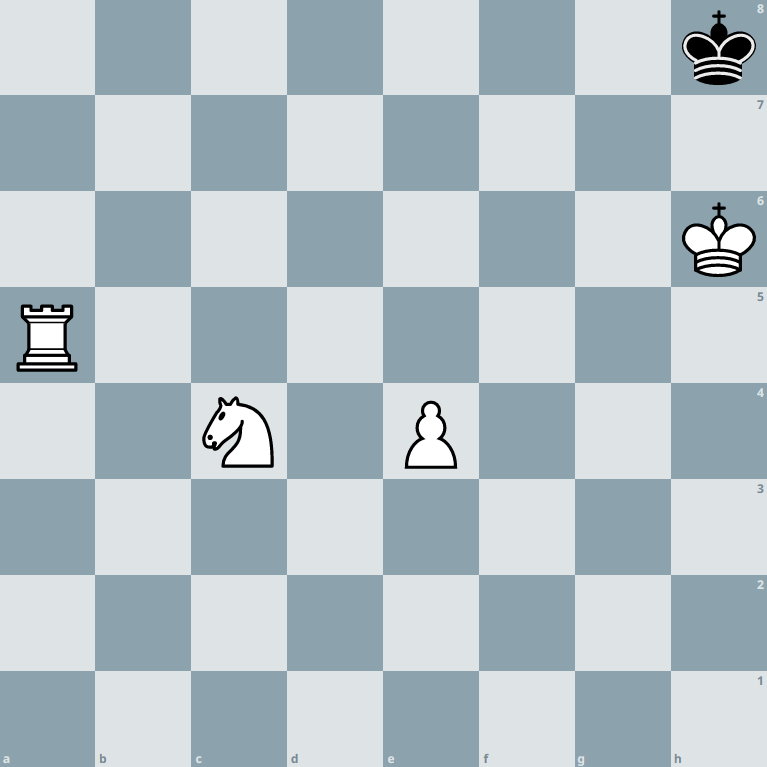
White to play and mate in 3


Medium difficulty brain teasers and puzzles
This is the famous Paul Morphy chess puzzle, rumored to have been composed by Morphy when he was just 10 years old!

White to play and mate in two moves.
View SolutionAt the beginning of January, you set a goal to work every day, to reach a total of 5000 minutes of work by the end of the month. But to give yourself a better shot of achieving this, you decide to front-load it—at the beginning of each day, you figure out how much you’d need to work on average on each remaining day to achieve your goal, and then you work double the amount you need to do. For example, if you had 50 minutes left and 5 days left, you would need to work 10 minutes/day, so you would choose to work 20 minutes on that 5th-to-last day.
If you chose to work this way, how long does it take you to complete your goal of 5000 minutes?
View SolutionA man is stranded in the wilderness, in a remote northern area. There’s a lake nearby, and utility poles carrying electricity, presumably to a nearby town. However, there’s no way he can make it to the town in the freezing cold weather.
The man has a dinghy, two paddles, and an axe, but no devices that can communicate with anyone and no way to make a fire.
How does the man manage to get rescued as quickly as possible?
View SolutionThe coin rotation paradox is a famous math problem with an unintuitive solution:
If you roll a coin around the edge of another coin of the same size, from an external perspective, how many rotations does the coin make by the time it returns to its original position?
Read MoreIn Dan Finkel’s TED-Ed video, he shares this math puzzle, paraphrased as follows:
Dr. Schrödinger is creating an army of giant cats for villainous purposes. Your team of secret agents has located his lab, but needs to get through his unusual security system.
The system displays a single number, and has three buttons that control this number:
Goal: make the numbers 2, 10, and 14 show on the display, in that order.
Rules:
How can you achieve this?
(Sorry, the giant cat army has nothing to do with the puzzle.)
Source: Dan Finkel and TED-Ed
Continue reading “Giant Cat Army Riddle from TED-Ed”The “boy or girl paradox” is a well-known brain teaser by famous puzzle-maker Martin Gardner. It’s popularly considered a “paradox” because (1) it has a highly unintuitive solution, and (2) its ambiguous wording meant either of two solutions could be valid solutions.
This is a rewording of that brain teaser to eliminate some ambiguity from that original question:
Out of all families with exactly two children, we randomly pick one family that has at least one boy. What is the probability that both children in this family are boys?
Assume only for the purposes of this puzzle that a child can only be a boy or a girl, and that either possibility is equally likely.
Read MoreThe two envelopes paradox is a famous brain teaser of sorts, and not a true paradox. The problem is generally posed like this:
You are given a choice between two identical envelopes. One envelope contains some amount of money, and the other contains twice that amount of money. There is no way to distinguish between the two. However, when you choose one of the envelopes, before opening it, you are given the option of switching to the other envelope. Should you switch?
Why is this sometimes called a paradox? Well, if you choose to switch, you have a 50% chance of doubling your money, and a 50% chance of halving your money. If the amount of money in the envelope you initially chose is M, this reasoning suggests the expected amount in the other envelope is (2M + 0.5M) / 2 = 1.25M. This is more than M, so you should always switch.
But that would suggest once you’ve switched, you’re in the same position you were before you switched, so you should switch again. What is the problem with this reasoning?
Read More