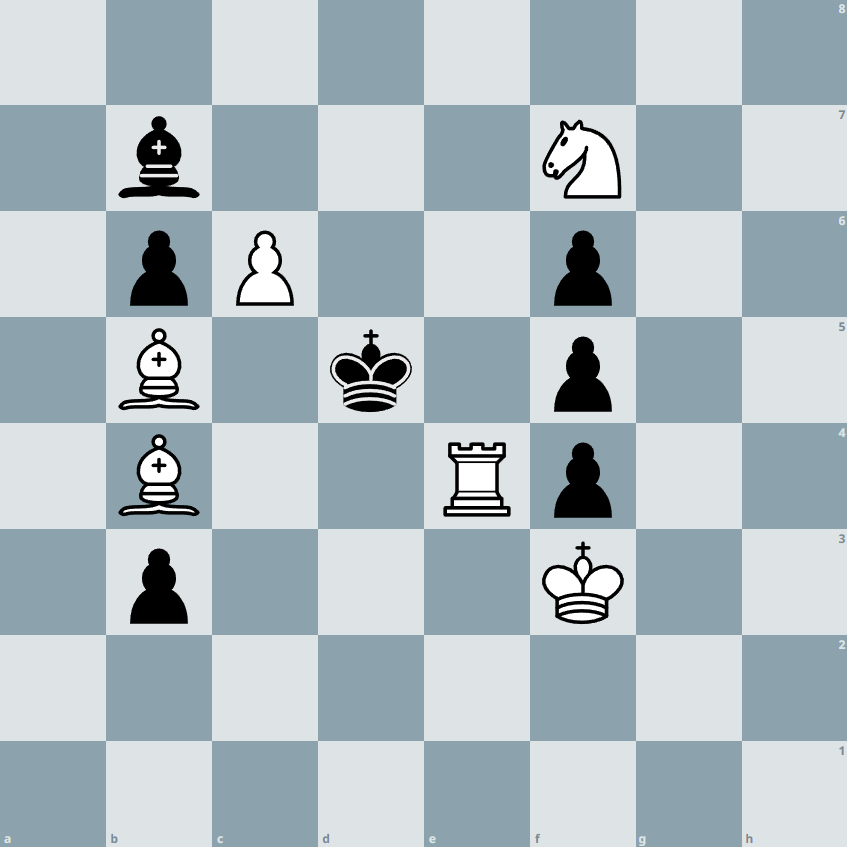
There are five points on a line. You measure the distances between every pair of points and you find:
2, 4, 5, 7, 8, __, 13, 15, 17, 19
This list is ordered from shortest to longest. What is the missing distance?
View Solution
Brain teasers, puzzles, riddles, and other challenges
There are five points on a line. You measure the distances between every pair of points and you find:
2, 4, 5, 7, 8, __, 13, 15, 17, 19
This list is ordered from shortest to longest. What is the missing distance?
View SolutionThree players gamble on a “doubling game.” In each round of the game, a single loser is determined, and this player has to double the money of the other two.
After three rounds of this game, each player has lost one round each, and each player now has $24.
How much money did each player start with?
View SolutionWhich of the following statements are true?
In Dan Finkel’s TED-Ed video, he shares this math puzzle, paraphrased as follows:
Dr. Schrödinger is creating an army of giant cats for villainous purposes. Your team of secret agents has located his lab, but needs to get through his unusual security system.
The system displays a single number, and has three buttons that control this number:
Goal: make the numbers 2, 10, and 14 show on the display, in that order.
Rules:
How can you achieve this?
(Sorry, the giant cat army has nothing to do with the puzzle.)
Source: Dan Finkel and TED-Ed
Continue reading “Giant Cat Army Riddle from TED-Ed”The “boy or girl paradox” is a well-known brain teaser by famous puzzle-maker Martin Gardner. It’s popularly considered a “paradox” because (1) it has a highly unintuitive solution, and (2) its ambiguous wording meant either of two solutions could be valid solutions.
This is a rewording of that brain teaser to eliminate some ambiguity from that original question:
Out of all families with exactly two children, we randomly pick one family that has at least one boy. What is the probability that both children in this family are boys?
Assume only for the purposes of this puzzle that a child can only be a boy or a girl, and that either possibility is equally likely.
Read MoreYou drink half a cup of water. Then I drink half of what is left.
Then you drink half of what is left after that, and I drink half of what is left after you drink.
This continues until the cup of water is all gone.
What proportion of the cup of water did you drink by the end?
Continue reading “Drink Half a Cup of Water”The two envelopes paradox is a famous brain teaser of sorts, and not a true paradox. The problem is generally posed like this:
You are given a choice between two identical envelopes. One envelope contains some amount of money, and the other contains twice that amount of money. There is no way to distinguish between the two. However, when you choose one of the envelopes, before opening it, you are given the option of switching to the other envelope. Should you switch?
Why is this sometimes called a paradox? Well, if you choose to switch, you have a 50% chance of doubling your money, and a 50% chance of halving your money. If the amount of money in the envelope you initially chose is M, this reasoning suggests the expected amount in the other envelope is (2M + 0.5M) / 2 = 1.25M. This is more than M, so you should always switch.
But that would suggest once you’ve switched, you’re in the same position you were before you switched, so you should switch again. What is the problem with this reasoning?
Read MoreFriedman numbers are positive integers that can be written as an expression of its own digits and basic arithmetic operations. While Friedman numbers don’t have much practical use, they can be fun and creative puzzles for all ages!
Here are some of the smallest Friedman numbers and their expressions:
The Online Encyclopedia of Integer Sequences (OEIS) has a more comprehensive list of Friedman numbers and variations.
Try to find expressions for these Friedman numbers:
1435 (easy)
35 × 41
2502 (easy)
2 + 502
28547 (hard)
(5 + 8)4 – (2 × 7)
123456789 (very hard)
((2 × 7 + 86)5 – 91) / 34