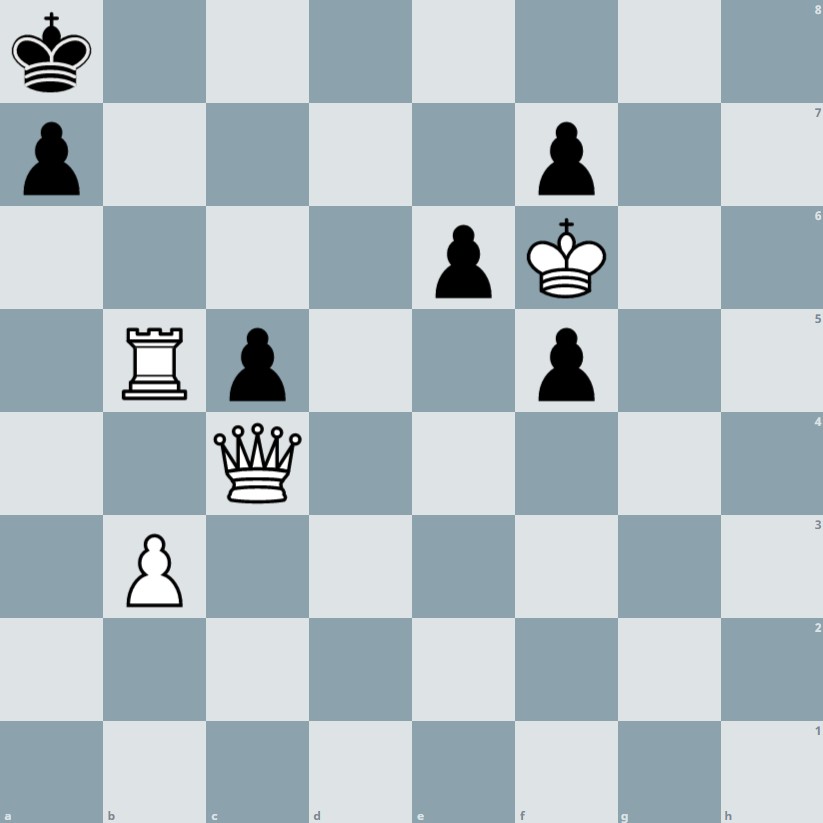
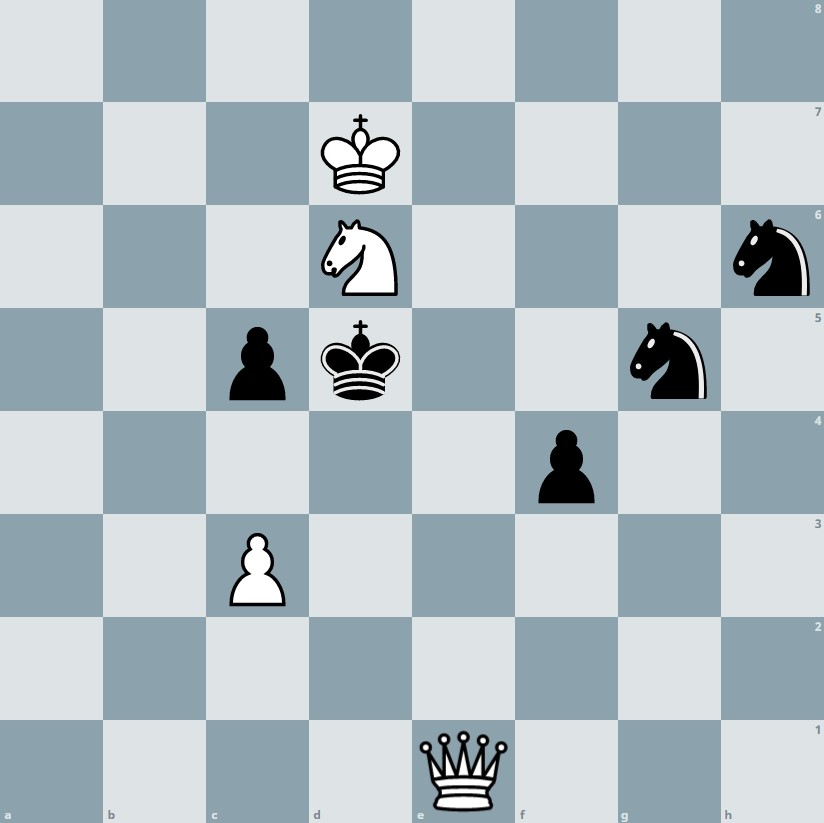
From its starting position, the white knight that captured the black queen has moved exactly eight times to get where it is now. How is this possible?

Medium difficulty brain teasers and puzzles
From its starting position, the white knight that captured the black queen has moved exactly eight times to get where it is now. How is this possible?
Six ants are walking at 1cm/second on a very narrow stick 100cm long:
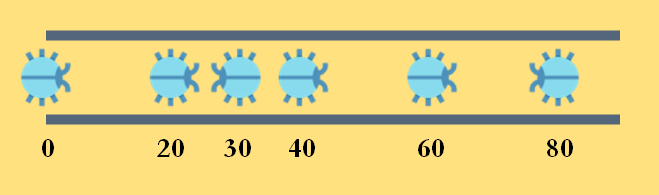
When two ants run into each other, they immediately turn around and walk in the other direction.
How long does it take before the last ant walks off the stick?
Continue reading “Ants on a Stick”When someone asks Casey how to spell her name, she helpfully offers:
Which is Casey most likely to use as a spelling aid for Y: yield, yearn, yacht, yellow, youth, or yank?
Continue reading “Phonetic Alphabet”The U.S. uses 5-digit zip codes to help determine where mail goes. Since mail can be oriented in all sorts of directions, they avoid assigning zip codes that could be confused with a different zip code when read upside-down. For example, 61666 could be confused with 99919 when upside-down, so mail could be accidentally routed to the wrong zip code if both were actual zip codes.
How many zip codes could be confused with a different zip code when read upside-down?
In the example above, 61666 and 99919 would count as two confusing zip codes. Also, zip codes are allowed to start with 0, such as 00501.
Continue reading “Confusing Zip Codes”Without using a calculator of any kind, figure out which is the larger root:
What common word or phrase is this rebus referring to?
U + WIN =
U + LOSE =
You win some you lose some
There is a standard deck of cards, with some cards face-up and the rest of the cards face-down. You are told exactly how many cards are face-up, but you are not allowed to look at the cards.
Without seeing which cards are face-up and which are face-down, how can you divide the deck into two piles of cards that contain the same number of face-up cards?
Continue reading “Equal Piles of Face-up Cards”There are two trains that run between two cities. The trains are identical and run on identical routes, so passengers have no preference between the two and would take whichever train that pulls into the station. The trains run at the same frequency: exactly once an hour.
You often travel between the two cities on a whim, and when you do so, you show up at the station at a completely random time. Yet after many trips over the years, you notice that you have taken one of the trains three times as often as the other. Is this just really bad/good luck, or is there another likely explanation?
Continue reading “Tale of Two Trains”