I am a solitary word.
If I lose my first letter, I remain the same.
If I lose my first letter again, I still remain the same.
What am I?
View Solution
Easy brain teasers and puzzles
I am a solitary word.
If I lose my first letter, I remain the same.
If I lose my first letter again, I still remain the same.
What am I?
View SolutionWhat common word or phrase is this rebus referring to?
 T  M  C
 A  U  O
 H  S  M
W T EWhat goes up must come down
The missing dollar riddle is a classic brain teaser that can trip up even savvy puzzle solvers:
Three friends split the cost of a hotel room. They are charged $30, so each of them pays $10.
Later the hotel manager realized the room only cost $25 instead of $30. The manager brings $5 to reimburse the friends.
The manager finds it hard to split $5 three ways, so he gives the friends $1 each, and keeps $2 for himself.
But wait – each friend paid $9, for a total of $27, and the manager pocketed $2. That’s 27 + 2 = 29, whereas they originally handed over $30. Where did the missing dollar go?
View SolutionWhen you throw a ball straight up, does it spend more time going up, more time coming down, or the same time going up and down – taking into account both gravity and air resistance?
Continue reading “Throwing a Ball”A small company is losing money and the boss is looking for ways to cut costs. The boss is a foolish gambler, so he offers two employees the choice of either taking flat 10% pay cut, or playing the following coin flip game for each paycheck:
The two employees take some time to work out a strategy, and then confidently accept the offer to play the coin flip game.
What strategy did they come up with that made them confident the coin flip game will give them more money?
Continue reading “Game the Coin Flip Game”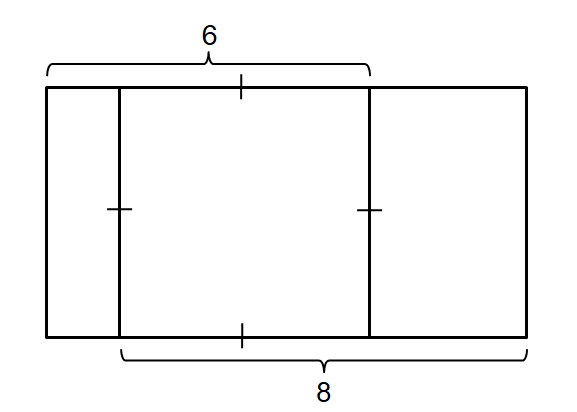
What is the perimeter of the outer rectangle? All angles shown are right angles.
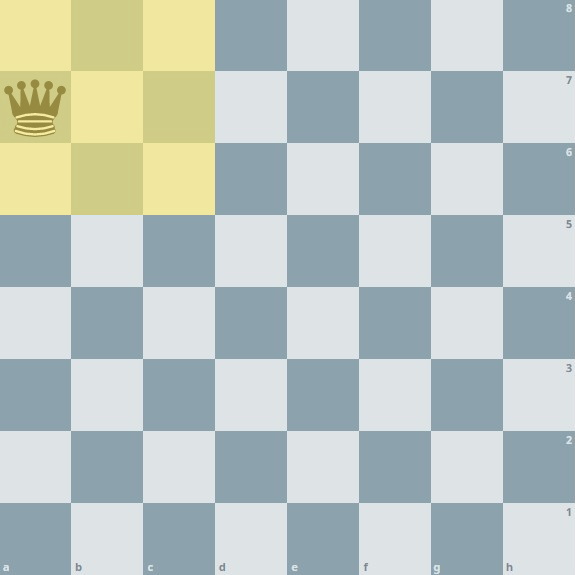
Continue reading “Unclear Perimeter”Starting from this position, can the queen touch or pass through all nine highlighted squares in just four standard chess moves?
P _ _ _ N T
D E _ _ _ ST
S T _ _ _
C _ _ _ E R
Which 3-letter word can be inserted into all four lines above to form complete words?
Continue reading “Complete the Words”There are 100 face-down cards. The first person that passes by flips over every card, the 2nd person that passes by flips over every 2nd card, and so forth – the n-th person that passes by flips over every n-th card. Before you know it, 100 people have passed by.
After all 100 people have passed by, which cards are face-up and which are face-down?
Fun fact, this was an actual brainteaser given to me in the first round interview for a hedge fund internship back in 2011.
Preparing for a brain teaser interview? Check out our ultimate guide to brain teaser interviews.
Continue reading “Flipping Every N-th”There are five candidates participating in an unusual election. There are four rounds of voting, and only two candidates participate in each round, with the winner moving on and the loser dropping out. This means first candidate 1 will run against candidate 2, then the winner will run against candidate 3, and so on, with the winner of the last round being elected.
Polling shows that Stephen Hawking is not very popular. There are five equal-sized groups in the voting population, and polling shows they prefer the candidates in the following order:
But Hawking has a secret weapon – he gets to choose the order the candidates participate in each round.
Is there a way for Hawking to organize the rounds such that he wins?
Continue reading “Rigging a Vote”